The Method

One Governed Source of Truth.

How can one engineer execute what used to take a team — without adding headcount, software, or hardware? Collect data once, decompose it with AI, input a specification, and AI generates — and executes — solution sets in parallel.

Why This Scales

Serial execution is capped by headcount.

Parallel execution isn’t — that’s the whole difference.

As-is workflow

Fixed resources, serial progression.

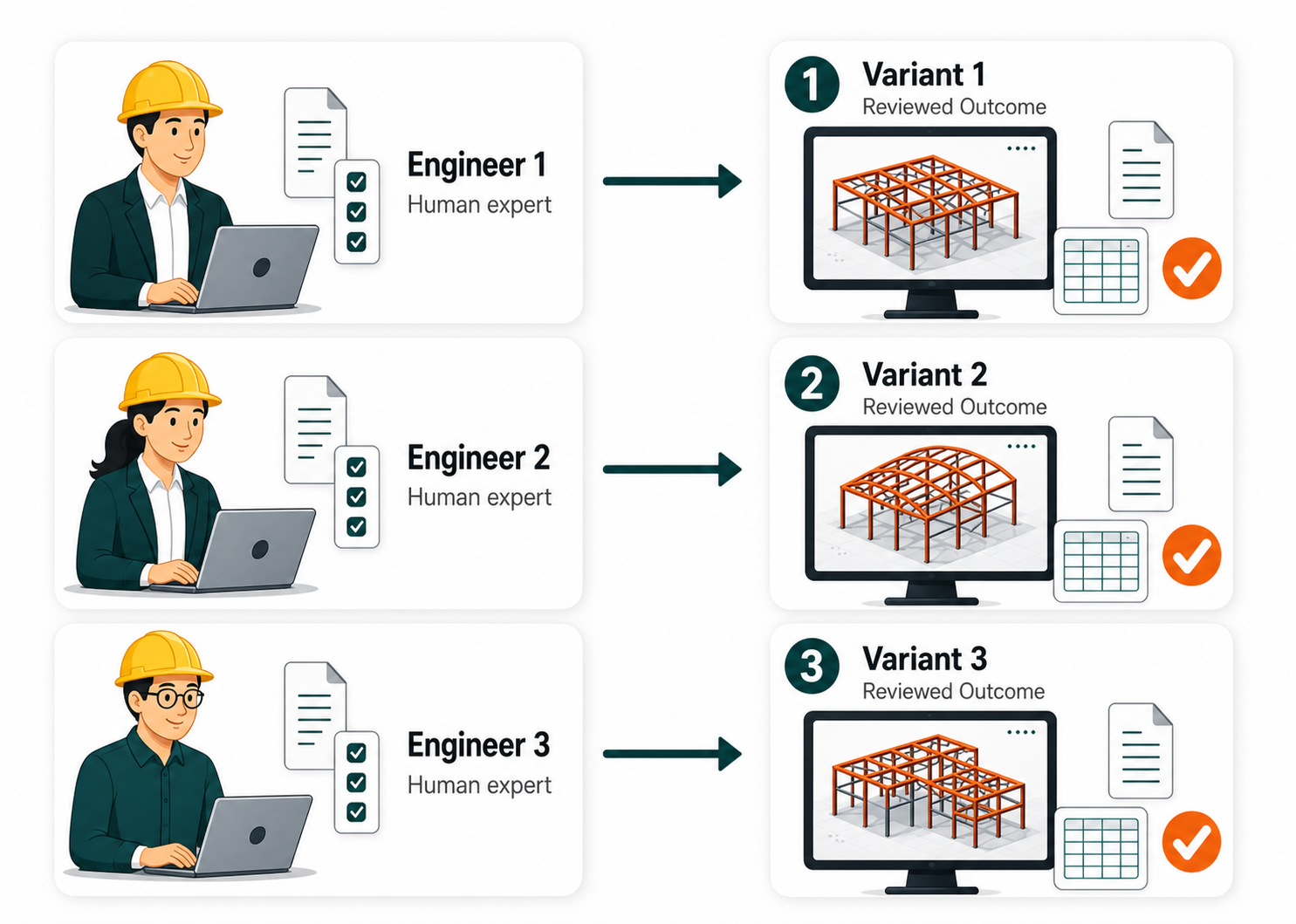
As-is engineering workflow scenario with multiple engineers producing separate reviewed variants

To scale up in the as-is scenario, you add resources at a 1:1 ratio. Scaling down means paying for unused resources. The cost of doing business is fixed: one engineer executes one deliverable, in a serial progression.

To-be: AI-optimized

Flexible resources, parallel execution.

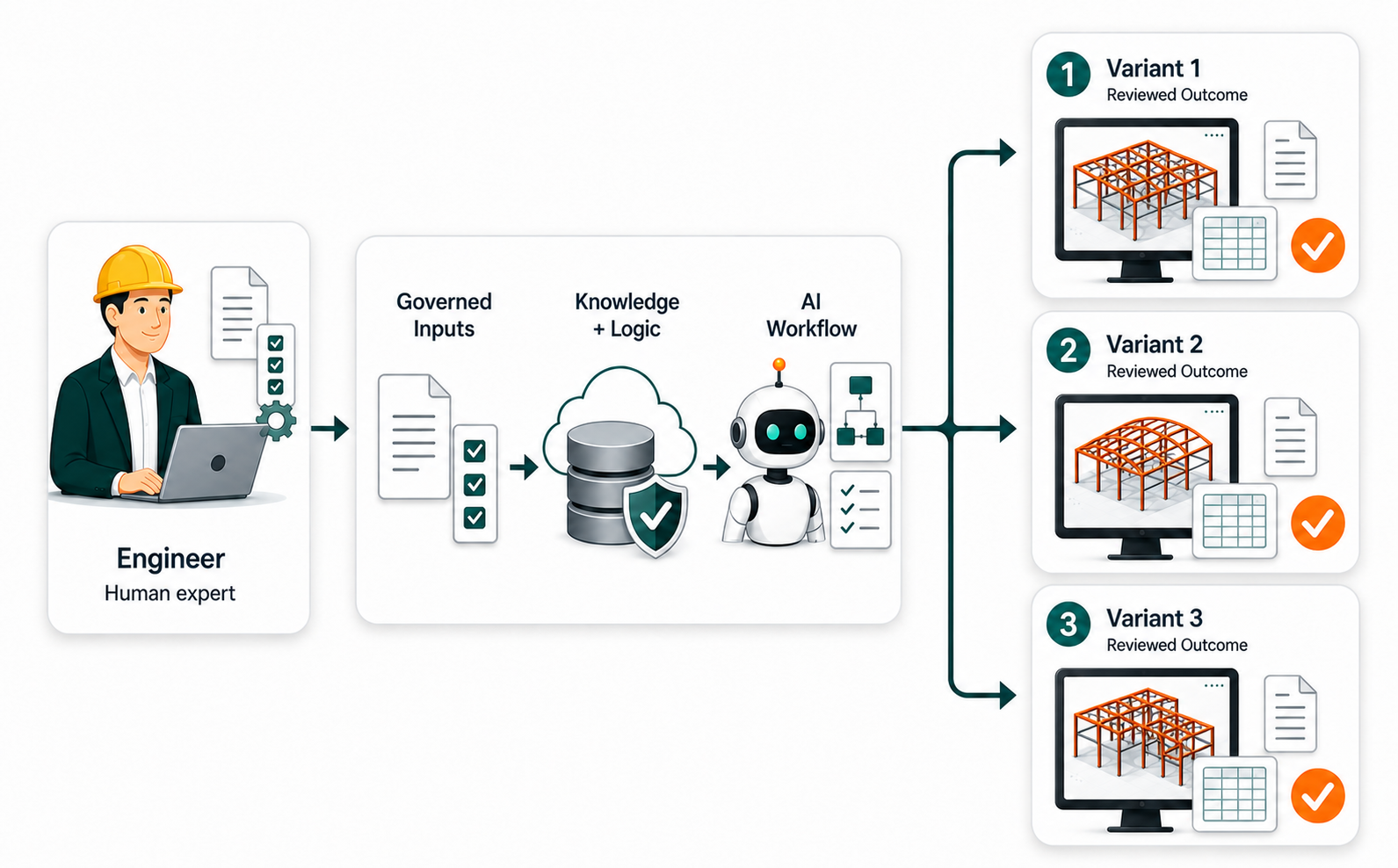
AI optimized workflow scenario with governed inputs, expert supervision, automation, and parallel reviewed outputs

To scale up in the to-be workflow, one engineer executes multiple projects or outcomes in parallel. Scaling up or down is a matter of how many parallel processes the engineer manages — not how many additional engineers, software licenses, or machines you add. The same resources, at no additional cost, and the savings grow the more parallel jobs are running.

Watch: Serial vs parallel with AI knowledge capture 1:32

Set the scale factor: 1 engineer = 1 outcome (traditional, no scaling) → 1 engineer × f(x) = 3 outcomes (scale) → 3 engineers × f(x) = 9 outcomes (scale up). The multiplier comes from parallel, AI-assisted execution — not from adding headcount.

The Workflow

Knowledge capture, trusted business process, best practice and rules.

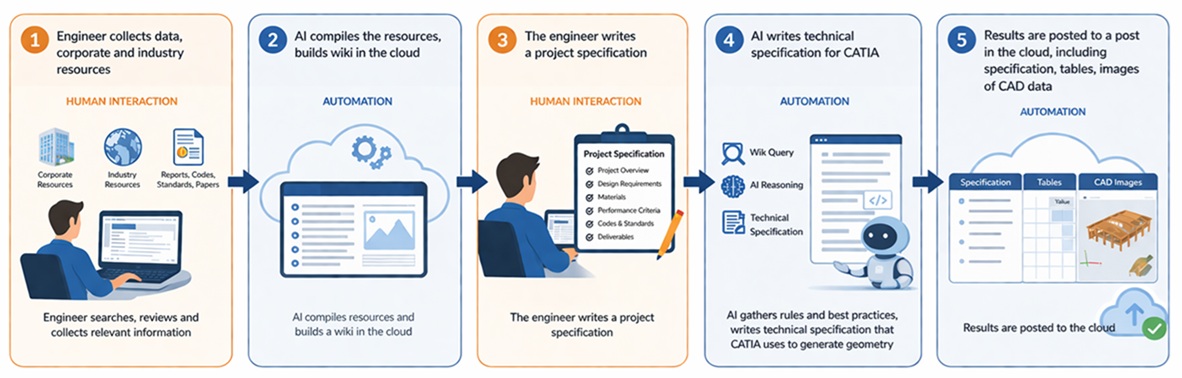
Five-component AI engineering workflow: the engineer collects corporate and industry data, AI compiles the resources into a governed knowledge base, the engineer writes a project specification, AI generates solution sets, and results are delivered as 3D data, 2D data, and documentation

Watch: The five-step workflow, end to end 2:46

The loop: collect, decompose, specify, generate, deliver — then feed lessons learned back into the first component.
01 Collect

Company best practice, engineering and manufacturing rules, and customer or project history go into the 3DEXPERIENCE database — a one-time effort that keeps paying off. Every project afterward adds its own lessons learned back into the same governed record.

  • Company best practice
  • Engineering and manufacturing rules
  • Customer or project historical data
  • Single source of truth — trusted, governed data
02 Decompose

AI reads what was collected, then organizes and relates it — categorizing rules, precedents, and history so they can be queried instead of just stored. This is what turns a data dump into structure AI can actually act on.

  • AI job to read the data
  • Organize the data
  • Categorize and relate the data
03 Specify

This is the one manual input the system still needs: a specification, stated per project and per customer. Every customer has unique product requirements to meet, product by product.

  • Per-project, per-customer effort
  • Product by product — unique requirements each time
04 Generate

AI analyzes the specification against the governed company data and proposes solution sets — not one answer, but several, with engineers in the loop to steer and review. This is where the multiplication factor begins.

  • AI analyzes the input and company data
  • Proposes solution sets, not a single answer
  • Multiple solutions processed in parallel, engineers in the loop
05 Deliver

There are potentially multiple solutions worth generating, and executing them in parallel — with the engineer approving each one — is what optimizes resources. This is the component that produces the outputs, ready to hand off.

  • 3D data
  • 2D data
  • Documentation
  • Parallel execution — optimizing people, software, hardware, and time
From Method to Your Project

See what this looks like applied to your project.

Describe what you are building and I will help you see whether this workflow fits, what data needs to be governed first, and what a proof of concept would need to show.